Friday, 26 April 2013

The New Toyota Vios 2013


The New Toyota Vios 2013 is finally here, not available in Malaysia yet but the Vios will look pretty much same if not identical to the one just revealed in Thailand. Designed to be more appealing to the younger generation, the new Toyota Vios certainly looks much better compare to the last generation that we Malaysian call it the “dugong Vios”.  Aligned with the New Toyota vehicles design theme, the New Vios certainly looks sportier, at some angle it reminds of the Ford Fiesta.
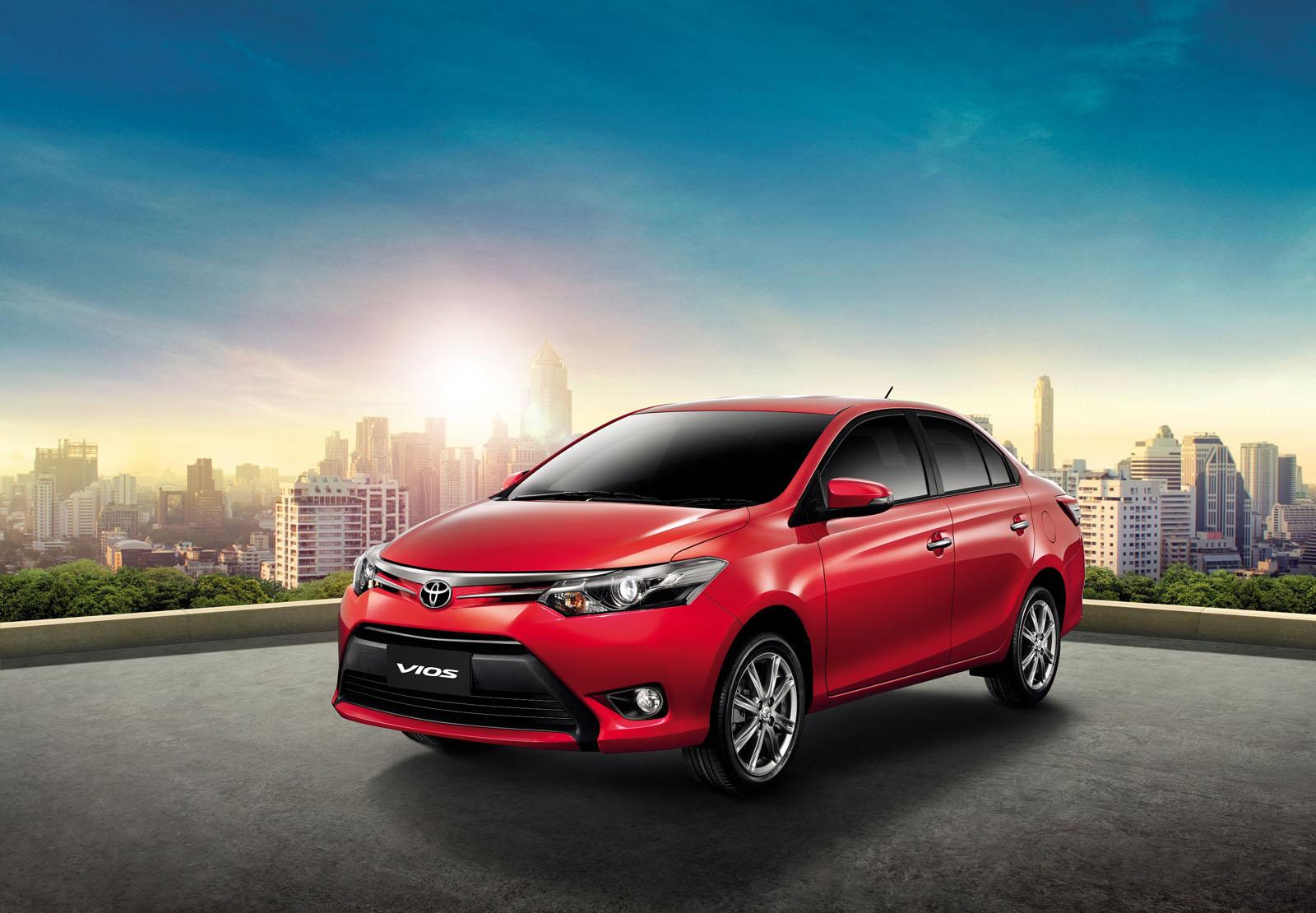
vios2013_15
Disappointingly it is still powered by the same 4 speed gearbox mated with 1.5L engine that produces 109 HP (80 kW) and 141 Nm of torque that is more than 10 years (since 2002). There will be a few variants of specs as we can expect here. In Thailand, the higher end model will have projector headlight, bigger wheels, all round disc brakes and some interior, exterior differences.
vios2013_18
The swift body lines helps the new Vios looks sporty, it makes us feel like the designer had took more effort when designing this Vios. The interior in 2013 Toyota Vios looks much better than generation as well. We see some resembles of the current Honda City. Toyota has got rid of the center speedometer design of the previous generation. Again, more swift lines continues of the design of the interior which makes the new Vios 2013 feels like it has upgraded itself to a different segment.
vios2013_16
The current Toyota Vios is sold around RM70,000+ to RM90,000 . We expect the new Vios 2013 will be priced at this range to keep the competition with the vast variety of competition in this segment ( Honda City, Nissan Almera, Mazda 2, Ford Fiesta & etc). By looks, we are quite confident it will do a good sale once it reaches our shore. However, we look forward for Toyota to bring in some new engine at our shores.

Friday, 19 April 2013

Toyota Predicts a Hybrid Majority


The man behind Toyota Motor Corp. ’s first generation of hybrids — or vehicles that blend a gasoline-based engine and an electric motor — wasn’t always so confident that the cars would be a hit.
Reuters
T
“When the question of the future of hybrids first came up…I’d felt quite bold in saying that Toyota cars will be 30% hybrid by 2020,” former chief engineer and current vice chairman Takeshi Uchiyamada told reporters at a briefing in Tokyo on Wednesday.
But now Toyota appears to be well on its way to that goal, and Mr. Uchiyamada is bolder. The company announced Wednesday it sold its 5 millionth hybrid car. Last year, 40% of the cars Toyota sold in Japan and 14% globally were hybrids.
“In eco-conscious countries, I believe that hybrid cars will become the majority,” Mr. Uchiyamada said, in a new prediction Wednesday. “I’d never really used the term ‘majority’ before, but I think it will go that way”.
Mr. Uchiyamada’s statements come after Toyota hybrid models Prius and Aqua grabbed the Nos. 1 and 2 spots, respectively, in fiscal 2012 sales by model in Japan, according to the Japan Automobile Dealers Association.
But hybrid cars still have a long way to go abroad. In the U.S., the market share of all hybrid vehicles was around 2.1% in 2011, according to market research from Baum and Associates and Hybridcars.com. In a 27-country average in Europe, the share of gasoline-electric hybrid vehicles didn’t even reach 1% in the same year.
Mr. Uchiyamada is confident, however, that hybrids are superior to other alternative-energy vehicles. He argues that the emissions technology for diesel vehicles is difficult to improve upon, and that recent hybrid models have the same level of heat efficiency as diesel cars.
Electric vehicles are “still far behind in terms of running distance,” he said. “The battery, the battery charging capability and the cost – these problems will not be quickly resolved.” Mr. Uchiyamada said fuel-cell vehicles – which run on hydrogen — are probably more viable as an alternative-energy technology, compared with EVs.
In recent years, Toyota’s hybrid sales have been growing at a faster pace. Since the launch of the first hybrid in 1997, it took 10 years to hit the 1 million mark, but only two more years to hit the 2 million mark. Toyota hybrid sales hit the 5 million mark just shy of a year since the last million benchmark.
Toyota has already announced plans to double its hybrid lineup by the end of 2015, adding another 18 models to the current 19. The question for the confident Mr. Uchiyamada now is: How quickly will the 6 million mark be hit?

Sunday, 14 April 2013

TOYOTA FT-HS


Car buyers face many tradeoffs-power vs. fuel efficiency, sport vs. practicality, convertible vs. hardtop, safety vs. size. Toyota's FT-HS Hybrid Sports Car concept is the next step in Toyota's have-your-cake-and-eat-it-too arsenal. This front-engine, rear-wheel-drive, 2+2 sports car is expected to produce 400 horsepower via its 3.5-liter V-6 hybrid engine. The FT-HS has targeted the sub-five-second zero-to-60 category, making it one of the quickest cars-err the quickest hybrid on the market (strange to use those two phrases in the same sentence).
The FT-HS's styling is certain to cause a stir as Toyota refers to it as a combination of "perfect imbalance." So-called "freeform geometrics" integrate fluid surfaces with hard corners, promoting airflow and reducing turbulence, which Toyota claims increases stability in high speed driving (translation: freeform geometrics is fancy terminology for functioning aerodynamics). "Integrated component architecture" is next in the design philosophy. This entails showing what needs to be seen-tail lamps spanning the width of the vehicle-and hiding what does not, al-la-retractable spoiler. Ultimately, the FT-HS styling goal is to achieve "subtractive mass", which is a minimalist style that is not only lightweight but also looks lightweight, according to Toyota. Our translation: The FT-HS has the same goal we do before a high school reunion; we want to be lightweight, but if that's a pipe dream, at least we can look lightweight.
The concept's interior is said to be modeled after a driver's cockpit (where have we heard this before?) but also offers structural functionality. A carbon fiber beam replaces the space normally occupied by the instrument panel, offering structural rigidity as well as a place to suspend the driver's controls. This beam adds to body stiffness, necessary when cruising with the open-top roof system stowed in the rear. Long live T-tops.
Toyota's concept promises everything we want in a car- power, performance, fuel efficiency, bold styling, and seating for more than two. One might think this miracle conveyance would be unobtainable to those without deep pockets. Wrong. The FT-HS concept adds a cherry-on-top, as it would be priced as an "attainable exotic" if it were produced. Rumor has it this concept might be fully attainable with Supra badging sometime around 2009 or 2010. We hope the result is more compelling than the like-powered Lexus GS450h which recently lost a sport sedan comparison test.

Saturday, 6 April 2013

Toyota RAV4 EV


Last week, we passed along the news that Toyota would be showcasing its electric RAV4, a vehicle being developed in conjunction with Tesla, at the L.A. auto show. We expected to get the usual full-info download and promised you more details when they surfaced, but we learned at the show that Toyota itself isn’t really sure of the vehicle’s specifics.
What we do know from seeing the car on the show floor is that the first round of Tesla-Toyota RAV4s will differ visually from the gas-powered models—a new front-fascia treatment loses the traditional grille and adds LED fog lights while the rear end receives a new tailgate without the RAV4’s standard spare-tire carrier. But even that might change by the time the RAV4 EV hits the market; Toyota made a point to say that the demonstration vehicles will be based on current-generation cars, which sure makes it sound like the appearance of the fully baked version will coincide with the launch of the next RAV4. So there’s one useful thing we learned—maybe.
Toyota reiterated that Tesla will be responsible for building the EV’s lithium-ion battery pack and powertrain components. The duo is aiming for a 100-mile range with no cargo space lost in the conversion. The team’s first goal is to produce 35 test vehicles, also referred to as “phase 0 cars,” for testing in 2011 before beginning production of the RAV4 EV the following year. Toyota says it’s aiming to make the “phase 1 cars,” due out around 2012, drive like a conventional RAV4.
In the meantime, we’re left hanging with Toyota stating that, “many decisions regarding both the product, as well as the business model, have not been finalized. Battery size and final output ratings, as well as pricing and volume projections of the vehicle Toyota plans to bring to market in 2012, have not been decided.” So, like we said, it’s all a bit nebulous.
Whatever plays out, expect the timeline to shift, as it does for all EVs.View Photo Gallery