Friday, 26 April 2013

The New Toyota Vios 2013


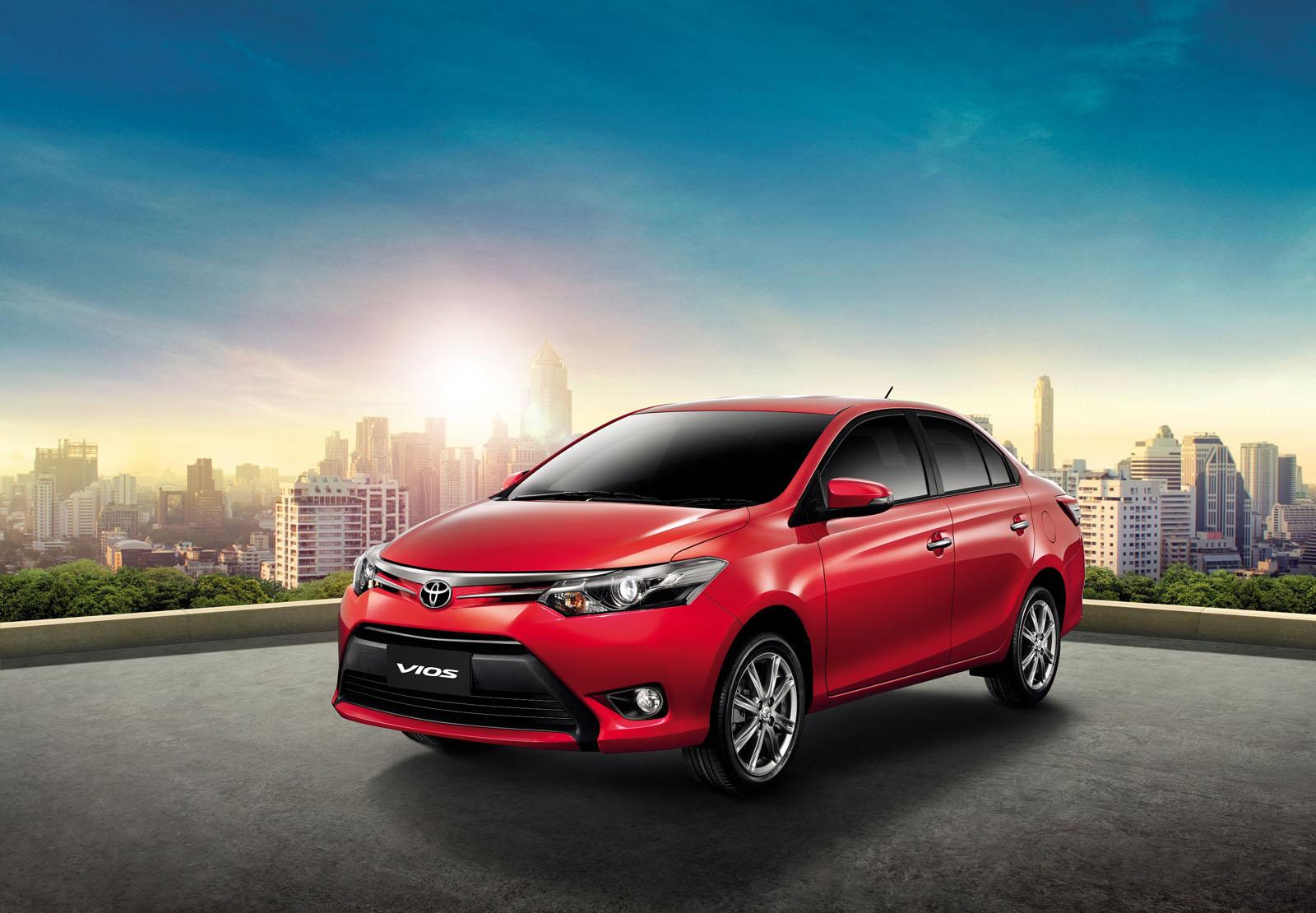
The New Toyota Vios 2013 is finally here, not available in Malaysia yet but the Vios will look pretty much same if not identical to the one just revealed in Thailand. Designed to be more appealing to the younger generation, the new Toyota Vios certainly looks much better compare to the last generation that we Malaysian call it the “dugong Vios”.  Aligned with the New Toyota vehicles design theme, the New Vios certainly looks sportier, at some angle it reminds of the Ford Fiesta.
vios2013_15
Disappointingly it is still powered by the same 4 speed gearbox mated with 1.5L engine that produces 109 HP (80 kW) and 141 Nm of torque that is more than 10 years (since 2002). There will be a few variants of specs as we can expect here. In Thailand, the higher end model will have projector headlight, bigger wheels, all round disc brakes and some interior, exterior differences.
vios2013_18
The swift body lines helps the new Vios looks sporty, it makes us feel like the designer had took more effort when designing this Vios. The interior in 2013 Toyota Vios looks much better than generation as well. We see some resembles of the current Honda City. Toyota has got rid of the center speedometer design of the previous generation. Again, more swift lines continues of the design of the interior which makes the new Vios 2013 feels like it has upgraded itself to a different segment.
vios2013_16
The current Toyota Vios is sold around RM70,000+ to RM90,000 . We expect the new Vios 2013 will be priced at this range to keep the competition with the vast variety of competition in this segment ( Honda City, Nissan Almera, Mazda 2, Ford Fiesta & etc). By looks, we are quite confident it will do a good sale once it reaches our shore. However, we look forward for Toyota to bring in some new engine at our shores.

Friday, 19 April 2013

Toyota Predicts a Hybrid Majority


The man behind Toyota Motor Corp. ’s first generation of hybrids — or vehicles that blend a gasoline-based engine and an electric motor — wasn’t always so confident that the cars would be a hit.
Reuters
T
“When the question of the future of hybrids first came up…I’d felt quite bold in saying that Toyota cars will be 30% hybrid by 2020,” former chief engineer and current vice chairman Takeshi Uchiyamada told reporters at a briefing in Tokyo on Wednesday.
But now Toyota appears to be well on its way to that goal, and Mr. Uchiyamada is bolder. The company announced Wednesday it sold its 5 millionth hybrid car. Last year, 40% of the cars Toyota sold in Japan and 14% globally were hybrids.
“In eco-conscious countries, I believe that hybrid cars will become the majority,” Mr. Uchiyamada said, in a new prediction Wednesday. “I’d never really used the term ‘majority’ before, but I think it will go that way”.
Mr. Uchiyamada’s statements come after Toyota hybrid models Prius and Aqua grabbed the Nos. 1 and 2 spots, respectively, in fiscal 2012 sales by model in Japan, according to the Japan Automobile Dealers Association.
But hybrid cars still have a long way to go abroad. In the U.S., the market share of all hybrid vehicles was around 2.1% in 2011, according to market research from Baum and Associates and Hybridcars.com. In a 27-country average in Europe, the share of gasoline-electric hybrid vehicles didn’t even reach 1% in the same year.
Mr. Uchiyamada is confident, however, that hybrids are superior to other alternative-energy vehicles. He argues that the emissions technology for diesel vehicles is difficult to improve upon, and that recent hybrid models have the same level of heat efficiency as diesel cars.
Electric vehicles are “still far behind in terms of running distance,” he said. “The battery, the battery charging capability and the cost – these problems will not be quickly resolved.” Mr. Uchiyamada said fuel-cell vehicles – which run on hydrogen — are probably more viable as an alternative-energy technology, compared with EVs.
In recent years, Toyota’s hybrid sales have been growing at a faster pace. Since the launch of the first hybrid in 1997, it took 10 years to hit the 1 million mark, but only two more years to hit the 2 million mark. Toyota hybrid sales hit the 5 million mark just shy of a year since the last million benchmark.
Toyota has already announced plans to double its hybrid lineup by the end of 2015, adding another 18 models to the current 19. The question for the confident Mr. Uchiyamada now is: How quickly will the 6 million mark be hit?

Sunday, 14 April 2013

TOYOTA FT-HS


Car buyers face many tradeoffs-power vs. fuel efficiency, sport vs. practicality, convertible vs. hardtop, safety vs. size. Toyota's FT-HS Hybrid Sports Car concept is the next step in Toyota's have-your-cake-and-eat-it-too arsenal. This front-engine, rear-wheel-drive, 2+2 sports car is expected to produce 400 horsepower via its 3.5-liter V-6 hybrid engine. The FT-HS has targeted the sub-five-second zero-to-60 category, making it one of the quickest cars-err the quickest hybrid on the market (strange to use those two phrases in the same sentence).
The FT-HS's styling is certain to cause a stir as Toyota refers to it as a combination of "perfect imbalance." So-called "freeform geometrics" integrate fluid surfaces with hard corners, promoting airflow and reducing turbulence, which Toyota claims increases stability in high speed driving (translation: freeform geometrics is fancy terminology for functioning aerodynamics). "Integrated component architecture" is next in the design philosophy. This entails showing what needs to be seen-tail lamps spanning the width of the vehicle-and hiding what does not, al-la-retractable spoiler. Ultimately, the FT-HS styling goal is to achieve "subtractive mass", which is a minimalist style that is not only lightweight but also looks lightweight, according to Toyota. Our translation: The FT-HS has the same goal we do before a high school reunion; we want to be lightweight, but if that's a pipe dream, at least we can look lightweight.
The concept's interior is said to be modeled after a driver's cockpit (where have we heard this before?) but also offers structural functionality. A carbon fiber beam replaces the space normally occupied by the instrument panel, offering structural rigidity as well as a place to suspend the driver's controls. This beam adds to body stiffness, necessary when cruising with the open-top roof system stowed in the rear. Long live T-tops.
Toyota's concept promises everything we want in a car- power, performance, fuel efficiency, bold styling, and seating for more than two. One might think this miracle conveyance would be unobtainable to those without deep pockets. Wrong. The FT-HS concept adds a cherry-on-top, as it would be priced as an "attainable exotic" if it were produced. Rumor has it this concept might be fully attainable with Supra badging sometime around 2009 or 2010. We hope the result is more compelling than the like-powered Lexus GS450h which recently lost a sport sedan comparison test.

Saturday, 6 April 2013

Toyota RAV4 EV


Last week, we passed along the news that Toyota would be showcasing its electric RAV4, a vehicle being developed in conjunction with Tesla, at the L.A. auto show. We expected to get the usual full-info download and promised you more details when they surfaced, but we learned at the show that Toyota itself isn’t really sure of the vehicle’s specifics.
What we do know from seeing the car on the show floor is that the first round of Tesla-Toyota RAV4s will differ visually from the gas-powered models—a new front-fascia treatment loses the traditional grille and adds LED fog lights while the rear end receives a new tailgate without the RAV4’s standard spare-tire carrier. But even that might change by the time the RAV4 EV hits the market; Toyota made a point to say that the demonstration vehicles will be based on current-generation cars, which sure makes it sound like the appearance of the fully baked version will coincide with the launch of the next RAV4. So there’s one useful thing we learned—maybe.
Toyota reiterated that Tesla will be responsible for building the EV’s lithium-ion battery pack and powertrain components. The duo is aiming for a 100-mile range with no cargo space lost in the conversion. The team’s first goal is to produce 35 test vehicles, also referred to as “phase 0 cars,” for testing in 2011 before beginning production of the RAV4 EV the following year. Toyota says it’s aiming to make the “phase 1 cars,” due out around 2012, drive like a conventional RAV4.
In the meantime, we’re left hanging with Toyota stating that, “many decisions regarding both the product, as well as the business model, have not been finalized. Battery size and final output ratings, as well as pricing and volume projections of the vehicle Toyota plans to bring to market in 2012, have not been decided.” So, like we said, it’s all a bit nebulous.
Whatever plays out, expect the timeline to shift, as it does for all EVs.View Photo Gallery

Saturday, 30 March 2013

Management changes 'huge turning point' for Toyota


"Nobody ever bought a Corolla because they thought they looked good driving them," Bob Carter said. "That will change."

NEW YORK – Toyota's U.S. management now has more autonomy to design cars and trucks specifically for American consumers under a new management structure announced earlier this month, Bob Carter, senior vice president of Toyota Motor Sales, said today.
Toyota, whose public image was badly hurt by recalls for unintended acceleration in 2009 and 2010, was slow to react and manage the crisis – in part because of a management structure that prevented quick decisions. The company also has been criticized for the bland and safe styling of its vehicles in recent years.
Now, a series of promotions and the appointment of outside board members announced is designed to address those issues, Carter said today in New York at the Automotive Forum.
"These were not just routine management shuffles," Carter said. "The changes we announced on March 6, signify a huge turning point for our company."
His comments today on the eve of the New York International Auto Show are among the first from a Toyota executive in the U.S. since the changes were announced.
Carter pointed out that Toyota promoted non-Japanese executives to lead three out of its four global regions. It also appointed three outside members to its board of directors, including longtime former General Motors executive Mark Hogan.Hogan, an independent consultant and former GM group vice president, has been Toyota President Akio Toyoda's friend since they worked together more than a decade ago at NUMMI, a California auto plant jointly run by Toyota and GM. Hogan has also previously advised Toyota.
"In the past, we've had critics who have complained that our global efforts were hampered by resisting bringing in outsiders and non-Japanese into the inner circle of our decision making," Carter said. "Well, not anymore."
Carter said the management changes are part of a broader strategic plan announced by Toyoda two years ago, shortly after the he took charge of the automaker founded by his grandfather.
"It has always been Akio's plan to build better cars, improve profitability and give each of the key regions around the world more autonomy," Carter said.
Carter argues that the results of that strategy are already evident in the design of the 2013 Toyota Avalon full-size sedan and the Toyota Furia, a concept car shown in January at the Detroit auto show.
The Avalon was completely designed in the U.S. in collaboration between Toyota's Calty design studio in California and its engineering center in Ann Arbor . It is built in Kentucky.
It is the first time, Carter said, that a new Toyota is 100% engineered, designed and built in the U.S. The result is a full-size sedan that has been praised for its more aggressive styling and design compared with the outgoing Avalon.
Meanwhile, the design of the Furia, which is the precursor to the next generation Corolla, also illustrates how Toyota is changing. The Corolla is Toyota's second-best vehicle behind the Camry, but is under pressure from new, more exciting looking cars such as the Ford Focus and Hyundai Elantra.
"Nobody ever bought a Corolla because they thought they looked good driving them," Carter said. "That will change."
Carter also said the next-generation Corolla will not be shown at the New York International Auto Show, but will be revealed before the LA Auto Show this fall.
"Watch your inboxes," Carter told a group of reporters after he spoke today.

Tuesday, 5 March 2013

2015 Toyota Supra


toyota supra picture
The Supra was a sports car produced by Toyota from 1979 to 2002. Its demise was due to restrictive emission standards, and it went away quietly into the night. Or did it? Rumors have been suggesting that the Supra name would be making a comeback and the fact that Toyota has just renewed the "Supra" trademark registration that expired back in 2006, leads us to the one logical conclusion: we will soon be able to drive around in a Supra again.
This evidence may all be there, but no one should expect the Supra anytime soon as Toyota is still busy fiddling around with their version of the FT-86. As if trying to outdo Subaru’s FT-86wasn’t enough - Hey Toyota, good luck with that - Toyota is also planning on a new MR2rumored to debut in 2013. So the Supra will be anything but chilling on the backburner until about 2015.
 New Toyota Supra due in 2014 - rumors
The last generation Supra was powered by a turbo engine with an output of 320 HP at 5600 rpm and 315 lbs-ft of torque, but don’t expect the same to happen with the next generation Supra.
UPDATE 12/05/2011: The return of the Supra name has been denied and confirmed by Toyota so many times, it’s equivalent to watching a tennis ball endlessly shooting over the net - back and forth, back and forth. Now, however, that game may finally be coming to a close. During the official debut of the GT 86, Chief Engineer Tetsuya Tada, said there was room for a three-tier sports car line-up in the Toyota range, with one car sitting below the 86 and one above it: "Right now the 86 will be a mid-size sports car. I would like to have one smaller and one larger. One would probably be a Supra follower. Nothing has been decided yet. It would [be] like a Supra successor."
We’ll see how long this story rides before Toyota throws another game into the set.
UPDATE 12/13/2011MotorTrend has offered new details on the new generation Supra set to be released in 2015. It seems that the car is being tested with a 3.5-liter V-6 hybrid system generating over 400 hp. It has also been rumored that the car will feature a design close to the FT-HS concept revealed at the 2007 Detroit show.
UPDATE 07/03/2012: A few days ago BMW and Toyota signed an agreement for co-developing a new sports car. And now, Automotive News is reporting that the next generation Toyota Supra could be built using the BMW 6-series architecture: "Anything is possible. The key factor is that the products of both companies retain their own individual character, despite jointly developed technologies."

Thursday, 28 February 2013

Toyota Highlander Review


Minivans aren’t cool. They actually neutralize any potential hipness within a three-car radius. Nothing screams “obligations” and “responsibility” louder or clearer than these family wagons. This is something that has not gone unnoticed by today’s drivers, who steer clear of vans the way anorexic supermodels avoid Chinese buffets. Naturally motorists still need cargo space and seating capacity, but they crave a more stylish package. This desire gave rise to the sport utility vehicle, out of which grew the modern crossover.

FAST FACTS

1. Three powertrains are offered including a 2.7-liter 4-cylinder, a 3.5-liter V6 and a hybrid.
2. The Highlander Limited provided for AutoGuide testing was powered by the optional 270 hp V6 engine.
3. Base price is just about $30,000 including destination and delivery charges, though range-topping hybrid can eclipse 47 grand!
These vehicles combine the functionality of a minivan with the rugged good looks of an SUV. Offered in all shapes and sizes they’re gaining momentum in the marketplace. Nameplates like Pathfinder and Explorer are former truck-based utilities that have changed their ways; just call them “born-again crossovers.” Vehicles like the Chevrolet Traverse, Mazda CX-9 and Hyundai Santa Fe are strong competitors as well.

BEAUTY IS MORE THAN SHEET-METAL DEEP


Toyota’s offering in this crowded segment is the Highlander. It’s a handsome hauler with smooth bodywork and a surprisingly understated design. Altogether it looks sleek unlike, say, the GMC Acadia, which is overly aggressive in appearance like a possessed bulldog.
2013 Toyota Highlander Limited 10
The same is true inside the Highlander, where stylists kept their cool. The overall design theme is friendly and functional. Additionally, the controls and interface elements are about as logical as they come, with one exception: the radio.
Two very large knobs protrude from either side of the dashboard’s center stack, above the ones that operate the climate-control system. They’re easy to see and even easier to grab onto, the only problem is they’re not what you think they are. In fact, they’re not even dials, just placeholders.
On the Limited-trim model provided to AutoGuide for testing they’re home to some warning indicators and the hazard-light button. Reaching for the nearest one and twisting it with the expectation of adjusting the audio volume results in frustration because it doesn’t turn. The radio is controlled by a duet of dials that are practically microscopic in comparison. Did you miss them in the pictures? Better look again. Those giant “knobs” are most likely used to operate the navigation system on Highlanders so equipped. Here they’re merely counterfeit controls.
2013 Toyota Highlander Limited 23
The car’s dashboard is made of attractively grained hard plastic, as are its door panels. However, it would be nice if the door tops were made of something soft. On a long trip your elbow may object to that rigid material, which probably rates at about 9.8 on the Mohs hardness scale, one step below diamonds. Thankfully all the doors’ lower surfaces are soft and squishy.

NOT-SO-MUSICAL CHAIRS


2013 Toyota Highlander Limited 16
When it comes to seating the Highlander is a star. The front chairs score top marks, while the second-row is nearly as roomy and comfortable. Interestingly that back bench can perform a neat trick. The center section can actually be removed and stowed under the front console. In its place a clever storage unit can be installed. It’s an interesting concept and one that’s executed quite well.

Of course that’s not all. The Highlander also offers a third row of seats. But be warned, it’s like a playground back there meaning kids only. Even most petite adult won’t fit very well, so don’t even try.
Along with (mostly) comfortable seats, fit and finish is another Highlander highlight. Everything in the vehicle’s cabin is just as it should be. World-class assembly quality gives the impression that Toyotareally cares about details, something its competition could learn a thing or two from.
If there’s one glaring flaw in this car’s interior it’s undoubtedly the headliner. It’s seriously cheap looking, bringing to mind a half-price Salvation Army sweater, all fuzzy and pilling. Toyota, you can do better than this, especially since the rest of the cockpit is so nice.
In keeping with its Scottish theme the Highlander’s seat-belt warning chime plays bagpipe music and drivers can opt for tartan fabric instead of leather. There’s also a dedicated haggis cubby in the glove box. Just kidding, but maybe engineers will incorporate these ideas in the next generation.

SMOOTH OPERATOR


2013 Toyota Highlander Limited 06
Putting the works in motion, the Highlander Limited delivers a smooth driving experience. It’s powered by a terrific 3.5-liter V6 engine that whips up a creamy 270 horsepower with a healthy serving of torque, 248 lb-ft to be precise.
Like the Honda Ridgeline we tested a couple weeks ago, the Highlander is equipped with an antiquated five-speed automatic transmission. It works just fine, but six gears are pretty much the standard these days; even more are preferable. It’s curious why some Japanese automakers are behind the curve, especially Toyota, since a six-shooter is standard on Highlanders powered by four-cylinder engines. That gearbox probably can’t handle the V6’s higher output.
Unlike the Ridgeline, the Highlander has nice steering feel. You won’t confuse it with a BMW M3 but it’s appreciably better than the artificial, robotic helm of the Honda.
2013 Toyota Highlander Limited 30
On the road this crossover absolutely coddles its passengers with a velvety smooth ride. It feels like the springs are made from down comforters and the shocks are filled with marshmallow fluff. It’s a perfect combination for Michigan’s decrepit roads, which are more pockmarked than the surface of the moon, or Berlin side streets circa April ‘45.
Of course the tradeoff for a supple ride is usually sloppy handling, and the Highlander does pitch and roll a bit while braking or taking sharp turns but it’s not that big of a deal. If you want a track car get a Porsche 911. This is a cushy family hauler that’s perfectly suited to its intended mission.

THERE CAN BE ONLY ONE (OR THREE)


2013 Toyota Highlander Limited 08
With a V6 engine and all-wheel drive on board the Highlander Limited should be able to get 17 miles of urban driving out of a gallon of regular-grade gasoline. On the highway it ought to hit 22. That works out to an average of 19 MPG, which is precisely what the trip computer reported after a week of testing. We were pretty hard on the car, taking full advantage of its smooth-running, 270-pony corral; it’s probable normal drivers would do even better.
If affordable efficiency is a priority then the four-cylinder model is right up your alley. It should return up to 25 miles per gallon on the interstate. It’s also the value leader of the Highlander lineup starting at just about $30,000.
But wait, there’s more! Just like a tawdry late-night infomercial there’s another model to talk about. The Hybrid version is the economy champion of the Highlander lineup, returning 28 MPG on both city and highway test cycles. But that added efficiency comes at a price. You can bet it’s more useful than a home podiatrist kit, though a lot more expensive than three easy payments of $19.99. Base MSRP is just about $41,000 and if you opt for the top-of-the-line version it eclipses 47 big ones! Bring your checkbook to the dealer along with your first- and possibly second-born children.
In Limited trim our test model stickered for an expensive but much more reasonable $41,855. The only option it was equipped with was a rear-seat DVD entertainment system, which cost $1,760.

THE VERDICT


2013 Toyota Highlander Limited 09
The Highlander is a solid offering in the three-row crossover segment. It can give any competitor a run for its money thanks to a unique combination of Toyota quality, interior comfort and butter-smooth ride. It’s not bad looking, either.
Sure, it may not be the most fun vehicle in its class to drive, that title probably goes to the 365-horsepower Ford Explorer Sport. It’s also missing at least one gear in its transmission, but betting dollars to doughnuts, the Highlander is a solid crossover that offers buyers a broad spread of trim levels and powertrain options. It’s competitively priced and probably as reliable as a blacksmith’s anvil, and that’s enough to make it a perfect minivan alternative.

Monday, 25 February 2013

2013 Toyota Avalon Hybrid Review


2013 Toyota Avalon Hybrid Review

Toyota’s flagship sedan gets amped up

By Craig Cole, Nov. 22, 2012, Photography by Craig Cole and Toyota
Toyota is the undisputed hybrid champ. Its Prius line is a household name, with buyers across the country fighting to purchase them like the last batch of Twinkies. But the company offers more economical automotive alternatives than just Prii. There’s an amped-up Highlander crossover as well as an electrified version of the ever-popular Camry. In an effort to leave no sliver of the market uncovered, the company is launching yet another hybrid with the 2013 Avalon.

FAST FACTS

1. The Avalon Hybrid is powered by a 2.5-liter four-cylinder gasoline engine that’s supplemented by an electric motor. Total system output is 200 hp.
2. Hybrid Avalons deliver up to 40 mpg in the city and 39 mpg on the highway. That makes for a combined rating of 40 mpg.
3. Toyota is targeting younger customers with the 2013 Avalon by cranking up the style and making it more fun to drive. Today, the car’s average buyer is in their mid 60s.
4. Toyota will offer a fleet-focused model to help fill the vacuum left by the discontinued Lincoln Town Car and they’re gunning to sell between 500 and 1,000 livery models in the first year.
This flagship sedan signals a bold, new direction for Toyota as the Japanese juggernaut is starting to deliver more passionate vehicles. The latest Avalon goes after younger buyers that want, in the words of Joel Fukumoto, a Product Education Manager at the University of Toyota, “less of a car that you ride in and more of a car that you drive.”

CURB APPEAL


“You always want the feeling of the sketch to be put in the real product,” said Miljan Jevremovic, Exterior Designer at Toyota and beaming father of the new, fourth-generation Avalon. He’s responsible for the initial drawing that became the basis of the car’s design.
Previous versions of the Avalon were about as exciting as a podiatrist’s waiting room. Breaking with this tradition, the 2013 model is strikingly similar to Jeremovic’s drawing. His idea survived the arduous product-development gauntlet making it from pen and paper to steel and stampings. He describes his initial illustration as “loose and fun;” it was something he quickly created at the end of a long day. The fact that his sketch got chosen out of hundreds of other drawings is a monumental achievement for a designer in his mid 20s. The fact that the company went with such a decisive look for the car is no less significant.
2013-Toyota-Avalon-Hybrid-Front-Three-Quarter3

The Avalon Hybrid has a refreshingly in-your-face appearance, something that’s been totally lacking in other Toyotas. It features an expansive lower-grille opening, sculpted flanks and a long, arching roof. The character line running along the body-side is an interesting flourish and one that was particularly challenging to produce. It features a double-negative shape – two convex surfaces coming together. According to Jeremovic, Toyota had to develop new metal-bending techniques to manufacture it.
2013-Toyota-Avalon-Hybrid-Front.jpg

Aside from its overall appearance, another area the 2013 Avalon Hybrid excels in is paint quality. Shiny and rich, it looks deeper than the Marianas Trench. The opulent finish is like a confectionary treat from a high-end pastry shop. Urges to lick the car’s glimmering paint were primal and barely resisted.

INTERIOR-ITY COMPLEX


Following its exterior cues, the interior is just as expressive. Open a door and it’s immediately obvious the new Avalon dispenses with its insipid past. The dashboard is a jamboree of swoopy shapes, hand stitches and cutting-edge electronics, features that would have been almost unthinkable in previous Toyotas.
There’s a lot to like about the cockpit. Materials are soft, the fit and finish is good and the standard leather-clad seats are cross-country comfortable. Toyota is quick to point out the chairs are more aggressively bolstered than the ones in today’s car, something that ties in with its sportier dynamics.
Sliding into the rear seat, things are just as upbeat. The Avalon’s back bench is comfy and spacious, with ample leg and headroom. Curiously, the previous generation’s reclining rear seats were deleted. Equally peculiar is the absence of fold-down backrests. A small pass-through in the center armrest is provided, though.
2013-Toyota-Avalon-Hybrid-Interior

The Avalon’s cabin may be posh but there are some drawbacks. The dashboard is draped in reflective “smoked chrome” accents. This bright work jazzes things up but it could pose a problem for drivers sensitive to glare, especially if they live in sunny areas. To be fair this may not be an issue; AutoGuide tested the Avalon Hybrid in Michigan on a depressingly overcast day. If you’re interested in the car and can’t stand blinding reflections make sure you test drive it when the sun is out.
At highway speeds things are relatively calm, although the Avalon seems a little louder inside than some of its competitors. A Toyota spokesman said they didn’t want to make the interior too quiet or people wouldn’t be able to have a conversation. Right . . . the car’s louder so people can talk more easily. We’re not buying it.
All Avalon drivers are treated to a keyless entry system with push-button start. But the fob is strictly municipal in its appearance with about as much flair as a voting booth. Sure, it gets the job done with all the functionality you’d expect, but a car this stylish, with this level of detail, deserves an equally upscale key. Toyota could learn a thing or two from Chrysler’s haute couture fobs.

2013-Toyota-Avalon-Hybrid-Center-Stack

ATKINSON DIET


The Avalon Hybrid shares essentially the same electrified drivetrain as the Camry Hybrid. This consists of a 2.5-liter four-cylinder powerplant that delivers 156 horsepower and an equal serving of torque. Helping it run as efficiently as possible, the engine utilizes something called the Atkinson cycle. It’s a slightly modified four-stroke combustion process that delays the closure of the intake valves during the compression stroke, a strategy that improves efficiency.
The engine is matched to an electric motor and a nickel-metal hydride battery pack. Combined, it delivers a total of 200 horsepower. On paper that doesn’t seem like enough oomph for a car weighing nearly 3,600 pounds, but thanks to a quick-witted continuously variable transmission (CVT) it moves quite well. Acceleration is surprisingly strong at all speeds. Toyota estimates it will sprint from zero to 60 miles an hour in roughly 8.0 seconds.
On the fuel-economy front, electrified Avalons are expected to deliver 40 miles per gallon in the city and 39 on the highway, making for a combined rating of 40 mpg.  Six-cylinder cars can only muster an estimated 21 city, 31 highway.

2013-Toyota-Avalon-Hybrid-Engine.jpg

DRIVERS NO LONGER TAKE A BACK SEAT


Toyota’s latest Avalon shares the same basic architecture as the outgoing model, which is a fine starting point for a large sedan. It inherits a rigid structure, acres of interior space and five-star safety. But today’s version is anything but driver-focused.
“I think the biggest challenge is we’re repositioning the car from a highway cruiser” said Fukumoto. Toyota has emphasized dynamics with the 2013 Avalon and it shows. The car’s ride is unexpectedly firm and body roll pretty well controlled. You’ll never confuse it with a Scion FR-S, but it is more engaging than before.
2013-Toyota-Avalon-Hybrid-Rear-Three-Quarter.jpg

Impacts served up by Michigan’s third-world roads are met with some starchiness in the suspenders, an unexpected upgrade. Also, the electrically boosted power steering has more life in it than you might expect.

SENSIBLE SHOES


Like the standard Avalon, hybrid models come with a long list of standard safety features and can be ordered with all kinds of high-tech goodies. Toyota’s Entune infotainment system is available. Other options include a Blind Spot Monitor with Rear Cross Traffic Alert, high-intensity discharge “Quadrabeam” headlamps and a power sunshade. Cruise control and a backup camera are standard fare, as are “IntelliTouch” capacitive controls for the climate and audio systems.
Just like the regular model, hybrid owners can adjust the way their Avalon feels. Three different drive settings are available. EV mode runs the car solely on electric power. A full battery contains enough juice to move the vehicle about one mile at speeds up to 20 miles an hour. Eco mode emphasizes frugal driving by reducing throttle response and backing off the climate-control system. Sport mode, as its name suggests, heightens the vehicle’s reflexes by improving accelerator tip-in and tightening the steering feel.

PRICING


The most affordable Avalon Hybrid is the XLE Premium, which stickers for $35,555. That’s $2,360 more than a comparable V6 model. The XLE Touring flavor comes with more features and starts at a slightly pricier $37,250. The Avalon Limited carries a manufacturer’s suggest retail price of $41,400. That’s $1,750 more than the comparable top-of-the-line gasser. All prices listed exclude shipping and handling fees, which are an additional $760.

2013-Toyota-Avalon-Hybrid-Rear-Three-Quarter2.jpg

THE VERDICT


Along with its six-cylinder sibling, the 2013 Avalon Hybrid marks a new direction for Toyota. It shows what the company can do when it focuses on building emotional products. The car’s exterior design is bold and distinctive, its interior cushy and well appointed. In hybrid form it’s pleasant to drive for a large sedan and its powertrain delivers fuel economy that’s nothing short of impressive.
Competition in the full-size segment is probably tougher than it’s ever been. Vehicles like the Hyundai Azera, Chrysler 300 and Buick LaCrosse are all capable challengers. Luckily for Toyota the Avalon is every bit their equal and thanks to a high-MPG hybrid offering, probably more.